Here are some words that may be new to you in Chapter 1, in the order in which they appear in the book:
Chemistry
As you probably know, everything in the world is made from atoms. These are the smallest unit you can have of a particular material – or element, to use the scientific word. There are 98 natural elements in the world, for example oxygen and carbon, iron and plutonium. Chemistry is the study of how these different atoms act, and how they react with each other.
Chemistry can explain everyday things like or why some materials become harder after you heat them. Sometimes when different chemicals are mixed you get surprising results. A simple chemistry experiment is to put vinegar and baking soda in bottle and shake it – but make sure you do it outside!
Electromagnet
An electromagnet is a type of magnet. The special thing about this type of magnet is that the magnetic field or force is created by the flow of an electric current – unlike a bar magnet where the metal itself has a magnetic field. Any wire with a current flowing down it will have a magnetic field around it, but if you coil the wire many times around a lump of metal the magnetic field it makes can be very strong.
They are used in many different ways: electric motors, magnetic locks (like your car doors), loud speakers and switches. It was a Danish scientist called Hans Christian Ørsted who first discovered in 1820 that electric currents create magnetic fields. But it was the British scientist William Sturgeon who invented the first electromagnet in 1824.
Typewriter
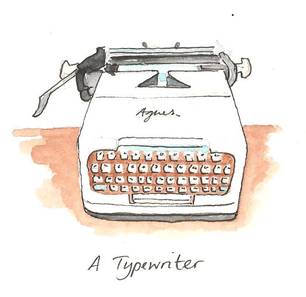
I can’t believe I have to explain this to you! Only a few years ago typewriters were still quite common, but now they are only to be found in people’s attics. They have been completely replaced with computers. A typewriter was a machine that was used to type letters and other documents, using printed letters instead of handwriting. They had keys for each letter, just like a computer keyboard. But when you pressed them a small arm with the letter on it hit an ink covered ribbon and printed the letter on the paper. If you made a mistake you had to start again!
Capacitor
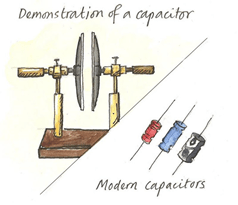
Have you ever taken an old computer apart and seen all the colourful blobs joined together with wires on a board? Well, we call that a circuit board and a capacitor is a component on a circuit board that can store and then release energy. It is made from two metal plates separated by a material that cannot conduct electricity. When it is connected to a battery an electric field is created between the plates that can store energy. The first man to make something like a capacitor was a chap called Ewald Georg von Kleist in 1745. He used his hand and glass jar filled with water – and got a nasty electric shock!
Speed-of-light
Light travels very fast. I mean very, very fast. So fast it is quite mind-boggling. A scientist will tell you that it travels at exactly 299,792,485 meters in a second, but that’s quite hard to imagine. It means that light can travel all the way around the world 7 times in a second! The fastest plane made by men (the Lokheed SR-71 Blackbird) still takes 12 hours to get round the earth – which means light is 300,000 times faster! That’s like comparing the speed of the world’s fastest car with a snail!
Could anyone draw an illustration for any of the words above that don’t have one? I’m sure you could think up something fun for Chemistry or the Speed-of-Light!
 Caleb and the Inventions