If you are thinking of taking up the story writing challenge, here are my top tips for anyone who wants to try and write a book. I’ll write later about the step by step process I follow to write one, but these are some things I have learned along the way that you might find useful to keep in mind at different stages of your writing project.
1. Don’t be too ambitious
Writing a book and seeing it through to completion can be a big job. Many people start writing and then run out of steam before finishing! It is better to start and finish a small book rather than only get part way through a big one. Finishing a book – even a small one – gives you a great sense of satisfaction and confidence to try something bigger.
2. Make sure you are excited about your idea
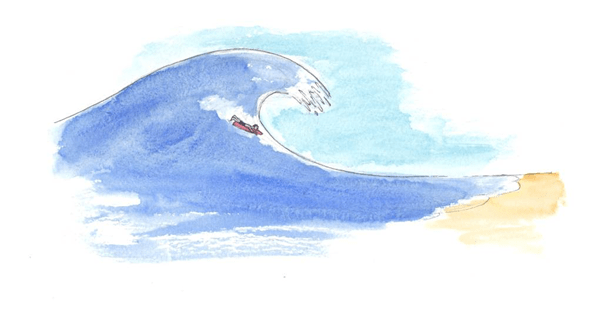
You need a lot of enthusiasm for your book project to see it through to completion. Your excitement about your idea is really important – it is like a wave that carries a surfer towards the beach. You need to make sure your idea excites you enough to get you through the hard bits and right to the end of the process.
3. Write about things that interest you
Often your idea will also reflect the things you are interested in. If you like a sport or a period of history it is a good idea for you to base a book around that interest. This has the added advantage that you can write about things you already know about, so you don’t have to research all the details to make it convincing – you already know about them!
4. Have a crisis that needs to be resolved
Just writing about what happens in someone’s day doesn’t make for an interesting story. Almost every story that has stood the test of time relies on their being some kind of crisis or problem that needs to be resolved. Just think of Cinderella – will the prince find her? Or David and Goliath – will the giant be defeated? A good crisis draws the reader in and gets them excited about what is going to happen.
5. Think: Beginning, Middle and End
Of course, whatever you write will have a beginning, a middle and an end! What I mean is that your book should fall into three parts (though they don’t have to be the same length). The beginning part is where you introduce the characters and the crisis. The middle part is where you develop the crisis and the characters’ efforts to resolve it. The end is where the crisis is resolved and the loose ends are tied up.
6. Pack in the surprises
The worst thing you can do when writing a book is to make it predictable. If the reader always thinks it is obvious what is going to happen then they won’t think it is worth reading any further! On the other hand, people love being surprised… You want your reader to keep saying “I didn’t see that coming!” And don’t just apply this to the action, make your characters and the settings for the action surprising and unexpected too!
7. Use stepping-stones
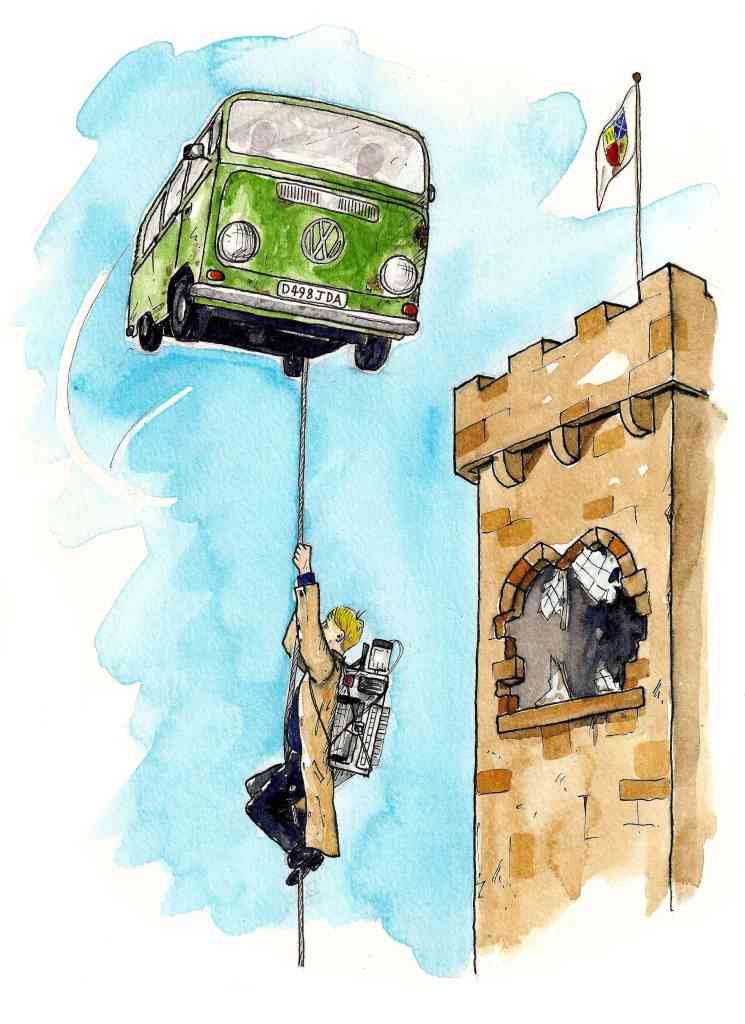
It is unlikely you will plan your story in great detail before you write it – I never do! However, it can be helpful to have some key stepping-stones in mind to get you from the beginning to the end, like crossing a river. I have these scenes as pictures in my mind (and often they end up as illustrations!). I work towards one, and then once I have reached that I work towards the next one and so on, until the book is finished.
8. Make Time
I wrote about the value of a deadline when launching the story writing challenge. It is probably even more important to make sure you regularly give a bit of time to working on your book, especially if it doesn’t really matter when exactly the project is finished. If you let too many days pass without spending time on it, you can easily forget where the story was going and start losing motivation.
9. Get feedback
Once you have finished a first draft (and checked it through yourself for obvious mistakes!) it is really important to let a couple of people you trust to read it and give you feedback. They may point out spelling and punctuation mistakes, or something that doesn’t make sense, or something about the story that could be improved. Acting on their comments will usually make your book better.
10. Finishing is more important than achieving perfection
Everyone gets tired of a project eventually, so it is better to get something finished that is good rather than aiming for perfection and never finishing it! Your can always encourage yourself that your next project will be better.
 Caleb and the Inventions
Thank you. Posts like these are more inspiring than you know.
LikeLike